
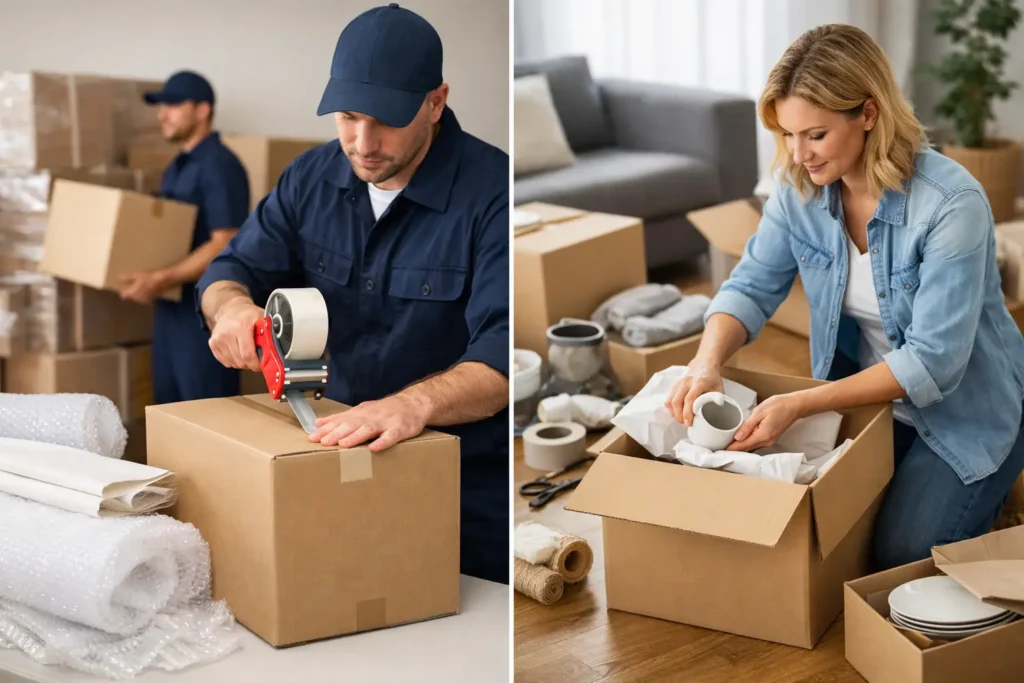
The real question behind packing service vs self packing is not which option is better on paper. It is which one gives you the smoothest move for your timeline, your household and your stress levels. A family moving out of a four-bedroom home has very different needs from someone relocating from a unit with a few boxes and basic furniture.
Packing looks simple until moving week arrives. Suddenly there are kitchen drawers still full, cords with no labels, odd-shaped items that do not fit neatly into boxes, and a growing worry about what might get chipped, scratched or crushed in transit. That is where the choice matters.
Packing service vs self packing: what is the real difference?
A packing service means trained movers pack some or all of your belongings using the right materials and a clear system. Self packing means you handle the wrapping, boxing, labelling and room-by-room prep yourself before the ute arrives.
On the surface, the difference seems obvious. One option saves you labour, the other gives you more direct control. In practice, the bigger differences are time, consistency, physical effort and the chance of damage caused by rushed or uneven packing.
Professional packing is usually less about convenience alone and more about reducing friction across the whole move. If everything is packed properly, stacked logically and labelled clearly, loading tends to run faster and unloading is easier to manage at the other end. Self packing can still work well, but it depends heavily on how organised you are and how much time you can realistically give it.
When a packing service makes the most sense
If your move is happening during a busy period of life, a packing service can remove a major source of pressure. Families juggling school runs, work deadlines and settlement dates often underestimate how long packing takes. What starts as a weekend job can drag into late nights across two weeks.
A professional packing team is also useful when the contents of your home need a bit more care than usual. Glassware, artwork, mirrors, kitchenware, electronics and sentimental items all benefit from proper wrapping techniques. The same goes for office relocations, where downtime and disorganisation can create headaches long after move day.
There is also the physical side of it. Packing is repetitive, awkward work. It involves bending, lifting, taping, sorting and making hundreds of decisions. If you are recovering from an injury, heavily pregnant, downsizing after many years in one home or helping an older family member relocate, handing over the packing can be the safest option.
For interstate moves, packing quality matters even more. The longer the trip, the more chance there is for items to shift during transport. Good packing helps protect your belongings and keeps the load more stable overall.
Where self packing has the advantage
Self packing suits people who want a slower, more hands-on process. If you have time to work through the house properly, it can be a good way to declutter and make decisions before moving day. You know what is essential, what can go into storage and what should not come with you at all.
It also works well for smaller, simpler moves. A one-bedroom unit, student move or lightly furnished townhouse is often more manageable without outside packing help, especially if you are already well organised. Some people simply prefer to handle personal items themselves, particularly documents, jewellery, medication and keepsakes.
There is an emotional side to this too. Packing your own home can give you a sense of control during a change that already feels big. For some households, that matters. A move is not just a logistics job. It is often tied to family changes, work shifts or a fresh start.
Still, self packing tends to go best when you are realistic about your capacity. Good intentions are common. Finished boxes are what count.
Time is usually the deciding factor
Most people do not choose between packing service and self packing based on theory. They choose based on the calendar.
If you have several weeks, a clear plan and enough energy, self packing may be perfectly workable. If your move date is close, access is tricky, children are underfoot, or you are trying to keep a business running at the same time, professional packing can take a huge amount of pressure off.
This is especially true when your move has fixed deadlines. Lease handovers, settlement dates and office vacates do not leave much room for half-packed boxes and last-minute scrambling. A structured packing service helps keep the move on schedule and reduces the chance that loading day starts in chaos.
Damage risk is not only about the ute
People often focus on transport when they worry about breakages, but a lot of damage starts during packing. Overfilled boxes split. Underfilled boxes collapse. Plates stacked the wrong way crack. Cables tangle, small hardware goes missing and heavy items end up in cartons that are too weak to hold them.
This does not mean self packing always leads to damage. It means technique matters. The way items are wrapped, cushioned, boxed and labelled has a direct impact on how well they travel.
A packing service brings consistency. Movers know which cartons suit books versus linen, how to protect corners, how to separate fragile items and how to stack for loading. That experience can make a noticeable difference, particularly with mixed loads and awkward household contents.
If you do self pack, the best approach is to pack like the boxes will be moved, lifted and stacked more than once, because they usually will be.
A blended approach often works best
This is where the decision becomes less all-or-nothing. Many moves benefit from a mix of both options.
You might pack clothes, toys and non-breakables yourself, then bring in professionals for the kitchen, artwork, fragile items or the final day before the move. That gives you control where you want it and support where it counts most. It also helps if you are mostly organised but know there are a few areas likely to blow out.
A partial packing service is often the most practical choice for busy households. It keeps the move moving without asking you to give up involvement entirely. It can also be a smart option for offices, where staff can box paperwork and basic desk items while movers handle equipment, shared areas and fragile pieces.
For many people, this middle ground is the answer to packing service vs self packing. You do not always need to choose one side completely.
Questions worth asking before you decide
Before locking anything in, think about your move as it really is, not as you hope it will be on your best day. How much time do you genuinely have this week? How much stuff is still unsorted? Are there fragile or valuable items that need special handling? Will you be packing around children, work commitments or property deadlines?
Also ask yourself how you usually cope under pressure. Some people are calm and methodical with a roll of tape in hand. Others would rather hand the job over and focus on cleaning, admin or getting the new place ready. There is no right personality type for moving, but there is a right setup for your situation.
If you are moving locally around Ipswich, local knowledge can help with timing and access, but the packing decision still comes down to workload and complexity. The route matters less than the preparation.
The best choice is the one that reduces moving-day stress
Packing service vs self packing is really a question of where you want to spend your energy. Do you want to put it into wrapping, boxing and labelling every room, or into managing the broader move and keeping life steady around it?
If your move is straightforward and you have time, self packing can work well. If your schedule is tight, your home is full, or you simply want more confidence that things are packed properly, a professional packing service can make the whole job feel more manageable.
At Springall Movers, we see this first-hand. The smoothest moves are not always the smallest ones. They are the ones where the packing plan matches the reality of the household.
A good move does not start when the ute arrives. It starts when the packing method fits your life, not the other way around.
One Response