
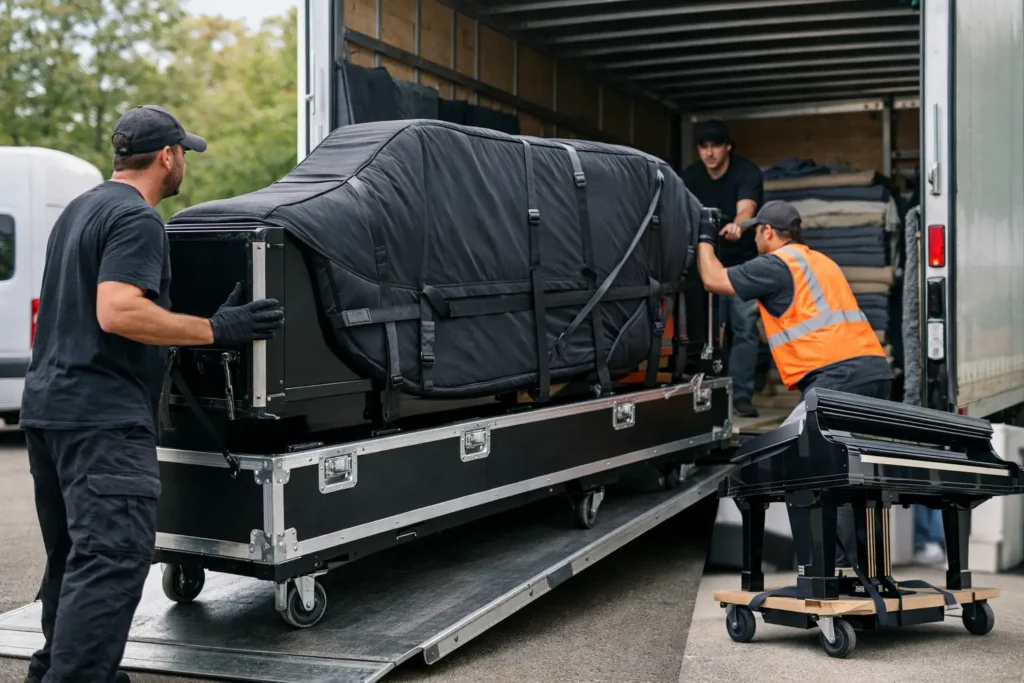
A piano does not give you much room for error. One awkward corner, one rushed lift, or one trolley used the wrong way, and the job can go from stressful to expensive very quickly. That is why this piano transport case study matters. It shows what careful planning looks like in a real move, and why the safest result usually comes from slowing down and doing the basics properly.
In this example, the move involved an upright piano being relocated from a family home to a new address after a downsizing move. On paper, it sounded simple enough. The distance was manageable, access at both properties looked reasonable, and the piano itself was a common size. But as with many specialty moves, the real work was in the details.
The job looked simple until access was checked
The pickup property had a narrow front entry, a short set of exterior steps, and a turn that left very little clearance between the wall and the handrail. Inside the home, the piano had been positioned in a living area with timber flooring and limited space to manoeuvre. At the delivery end, access was better, but there was a sloped driveway and a tighter-than-expected path into the house.
This is where many piano moves become harder than customers expect. Weight is only part of the issue. Shape, balance, flooring, gradients, door widths, and stopping points all matter. A piano can be moved safely through a difficult space, but only if the route is checked properly before anyone starts lifting.
In this case, the first decision was not about speed. It was about control. The route from the living room to the truck was assessed step by step so the team could identify where the piano needed to be steadied, where protective materials were needed, and where communication had to be especially clear.
What this piano transport case study shows about preparation
Preparation is what separates a controlled move from a risky one. Before the piano was shifted, the keyboard lid and moving parts were secured, the exterior was protected with padded coverings, and the route was cleared fully. Loose mats, décor items, and anything that could catch wheels or distract the team were removed.
The team also checked the truck setup before bringing the piano outside. That sounds basic, but it matters. If the vehicle is not ready, the piano can end up waiting in an exposed or awkward position while adjustments are made. The safer approach is to have restraints, ramps, padding, and placement space sorted before the item even reaches the door.
There is also a people factor that often gets overlooked. Piano transport is not just about strength. It is about coordination. Everyone handling the item needs to know the next movement before it happens. On this job, clear call-outs were used at every change in angle, every step, and every transition between surfaces. That kind of communication keeps the load stable and reduces the temptation to rush.
The biggest risk was not the weight
Many people assume the greatest risk in piano transport is sheer heaviness. In reality, balance is often the bigger issue. Upright pianos can be top-heavy, and their weight is not always distributed in a way that feels predictable when turning through tight spaces.
That became clear at the first doorway. The piano could fit, but not in a straight line. It needed to be rotated carefully while staying supported on stable equipment and protected from contact with the frame. This was the point in the job where planning paid off. Because the route had already been tested visually and measured, the team knew the angle required and the order of movement.
There is a lesson here for anyone comparing moving options. A piano move is rarely just a heavier version of moving a lounge or a fridge. The margin for error is smaller. Surfaces can be marked, internal components can be affected, and injuries become far more likely when people try to improvise.
Loading required patience, not force
Once outside, the next challenge was the short run from the entry to the truck. The ground was stable, but the path included a slight change in level that could have caused a sudden shift if the piano was rolled too quickly. Instead of trying to power through it, the team kept the pace slow and even, with one person guiding balance and the others controlling movement.
Loading into the truck was done with the same mindset. This is another point where jobs can unravel. If an item reaches the vehicle safely but is not secured correctly, the transport stage creates a fresh set of risks. A piano must be positioned to limit movement, protected from nearby items, and restrained so that braking and turns do not transfer force through the body of the instrument.
In this case, the loading plan allowed the piano to travel in a stable position with dedicated protection around it. Other household items were arranged to avoid pressure points and shifting contact. That may sound obvious, but mixed loads can create problems if the truck is packed around the piano as an afterthought.
Delivery was easier, but still needed care
The new home had fewer obstacles inside, but the sloped driveway meant the final part of the move still required concentration. A common mistake at delivery is assuming the hard part is over once the item has reached the new address. In practice, fatigue can set in at exactly the wrong time.
This piano transport case study showed why consistency matters from start to finish. The same slow handling, route checking, and communication used at pickup were carried through at delivery. Floor protection was laid where needed, the path inside was checked again, and the piano was placed carefully in its new position without scraping walls or rushing the final adjustment.
That final placement matters more than many people realise. Customers are not just trying to get a piano from one suburb to another. They want it set down safely, in the right room, without damage to the instrument or the home. A careful finish leaves people confident the whole move was handled properly.
What went right, and why it mattered
The success of this move did not come from any one dramatic moment. It came from a series of sensible decisions made early and followed through properly. The route was assessed before movement began. Protective materials were used before contact became a risk. The truck was prepared ahead of time. The team communicated clearly and kept the pace steady.
Just as important, no one treated the job like a standard furniture move. That mindset makes a real difference. Specialty items need specialty thinking. When movers respect the weight, balance, and vulnerability of the item, the whole process becomes calmer and more predictable.
There is a trade-off, of course. Careful piano transport can take longer than customers first expect, especially where stairs, narrow access, or sloped surfaces are involved. But extra care at the right moments is far better than trying to save a few minutes and creating damage that cannot be undone.
What homeowners can learn from this case
If you are planning a piano move, the useful takeaway is not that every job will look exactly like this one. It is that good outcomes usually start well before moving day. Clear access, honest information about stairs and tight spaces, and realistic timing all help the move run more smoothly.
Photos can help, but they do not always show depth, slope, or turning space properly. That is why experienced assessment matters. A doorway may be wide enough on paper and still be difficult because of the approach angle. A driveway may look manageable and still affect control if the surface falls away more than expected.
It also helps to understand that piano transport is not an area where shortcuts pay off. Friends with good intentions, general trolleys, or a last-minute plan can turn a manageable job into a risky one. The better approach is one built around equipment, handling experience, and a process that puts safety first.
For families already juggling a house move, downsizing, or storage arrangements, that peace of mind matters. It removes one of the most nerve-racking items from the day and replaces guesswork with a clear plan. That is a big part of what dependable movers bring to specialty transport.
Springall Movers understands that a piano is not just another heavy item on the list. It is often valuable, sentimental, and difficult to replace. When a move is handled with patience, planning, and proper care, the result is not just a successful delivery. It is one less thing for the customer to worry about when a lot is already changing.
If you are preparing for a piano move, the best starting point is simple: treat access, timing, and handling as seriously as the instrument itself. That is usually where the smoothest moves begin.