
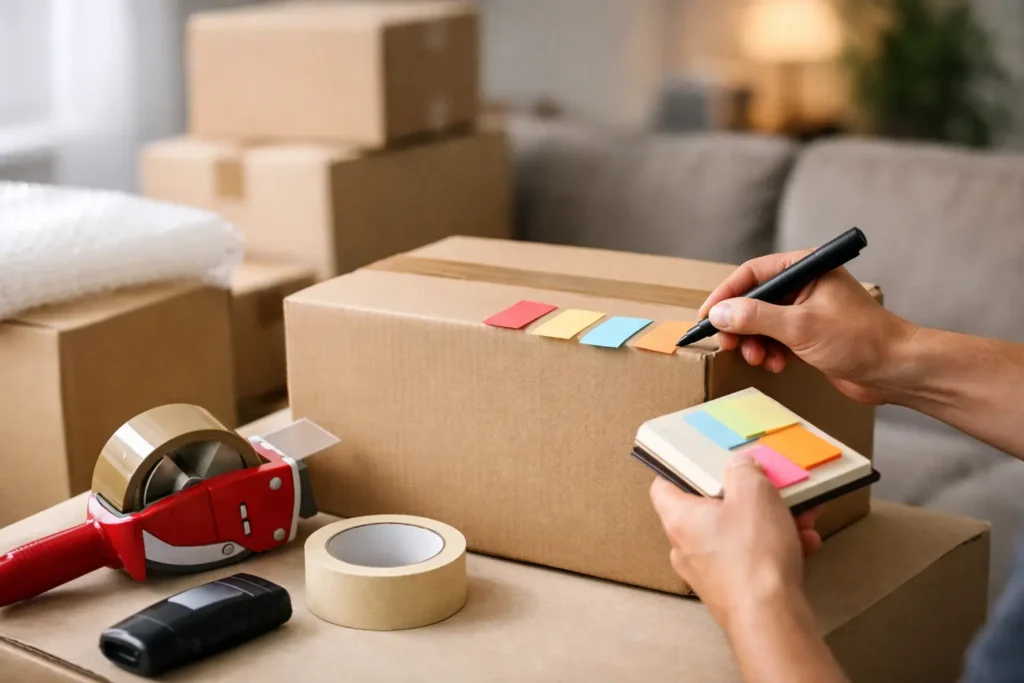
You only need one box marked “misc” to understand why the best way to label boxes matters. It usually turns up late, gets opened first, and somehow contains a phone charger, three candles, a kettle lid and the screws for the bed frame. On moving day, that kind of guesswork slows everything down.
A good labelling system does more than help with unpacking. It helps movers place boxes in the right room, keeps fragile items from being stacked the wrong way, and saves you from tearing through ten cartons just to find the kids’ school uniforms or the coffee mugs. The right approach is simple, clear and easy to follow when you’re tired and under pressure.
The best way to label boxes starts with one simple rule
Label for the person carrying the box, not just the person unpacking it.
That sounds obvious, but a lot of people write labels that only make sense later. “Lounge room decor” might help when you unpack in a week, but it does not tell anyone whether the box is fragile, whether it should stay upright, or whether it needs to be opened early. A better label gives useful information at a glance.
The most effective box labels include three things: the destination room, a short description of contents, and any handling note that matters. For example, “Kitchen – plates and bowls – fragile” is far more useful than just “Kitchen” or “Fragile” on its own.
That balance is the sweet spot. Too vague, and you create confusion. Too detailed, and you waste time writing an inventory on every carton.
What to write on every box
If you want a system that works on a real move, keep it consistent across every room. Write the room first in large, clear letters. Then add a brief contents note underneath. If the box needs special care, add that last.
A label such as “Main bedroom – winter clothes” tells you where it goes and what is inside. “Office – monitor stand and cables – this side up” is even better if the contents need careful placement.
It also helps to number boxes if you’re packing a full house or office. You do not need a master spreadsheet unless you like that level of detail, but numbering can help you quickly spot whether anything has been left behind in the truck, garage or storage unit.
Keep your wording practical. “Bookshelf bits” is more helpful than “assorted items”. “Pantry – oils and spices” is better than “food”. You are writing for speed and clarity, not perfection.
Where to place labels so they can actually be seen
One of the most common mistakes is writing on the top of the box only. That works when boxes are spread across the floor, but not when they are stacked in a truck, garage or spare room.
Write on at least two sides and the top. Side labels are the ones movers and family members will spot first when boxes are packed tightly together. If a box is likely to be stacked, the top label may disappear from view until much later.
Use a thick black marker so the words are easy to read from a short distance. Pale pen on brown cardboard is a poor combination, especially in low light or at the end of a long moving day.
If you are using pre-printed labels, make sure they stick properly. Half-peeled labels cause more trouble than they solve.
Should you use colours, numbers or both?
For most households, the best way to label boxes is to combine words with either colours or numbers, not replace words with them.
Colour coding is useful because it speeds up sorting. If all kitchen boxes have blue tape and all bathroom boxes have green tape, people can work quickly without stopping to read every label in full. This is especially handy in busy family moves or office relocations where there are lots of similar cartons.
Numbers are helpful when you want a bit more control. Box 1 of 8 for the kitchen gives you a rough check on whether all items have arrived. That matters more if some boxes are going into storage, or if the move is happening in stages.
But colours and numbers only work if they stay simple. If you create a system with ten colours, subcategories, symbols and abbreviations, it can fall apart the moment someone else tries to help. The easier it is to follow, the better it works.
Fragile labels are useful, but only if you pack for them too
People often rely too heavily on the word “fragile”. It is important, but it is not magic.
If a box contains glasses, ceramics or electronics, mark it clearly as fragile and add an arrow or “this side up” if orientation matters. That said, labelling cannot make up for poor packing. A badly packed carton of glassware with one small fragile sticker is still a risk.
Try to be specific where it counts. “Fragile – glassware” gives better context than a generic warning. “Fragile – lamp base” or “Fragile – printer” tells whoever handles it that this is not just another mixed box.
And be honest with the weight. A box marked fragile but packed like a bag of bricks is awkward and more likely to be mishandled. Heavy items belong in smaller boxes, even if that means using more of them.
The rooms that need extra thought
Some rooms are easy to label. Linen, books and spare shoes are fairly straightforward. Others are where labels make a real difference.
The kitchen is one of the biggest trouble spots because it usually contains a mix of fragile items, pantry goods and daily-use essentials. Break it down into smaller categories such as “Kitchen – mugs”, “Kitchen – pantry” and “Kitchen – everyday items” rather than packing the whole room into broad labels.
Bedrooms can also cause confusion, especially in family homes. “Bedroom” is not enough if there are three of them. Use specific labels like “Eldest child’s room” or “Main bedroom wardrobe”.
For offices, cable boxes deserve extra care. A carton labelled “Office – cords and chargers” sounds minor until nobody can set up the computers on Monday morning. The clearer you are here, the easier the restart.
What not to do when labelling moving boxes
A few habits create avoidable chaos.
Do not use vague labels such as “stuff”, “misc”, “spare” or “odds and ends” unless you genuinely want to play detective later. Do not switch between room names like “living”, “lounge” and “family” if they all mean the same space. Pick one term and stick with it.
Avoid overfilling boxes and then trying to warn people with extra writing. “Heavy” should be a clear note, not an apology for a box that should have been repacked. And do not leave labelling until the end of packing. If you seal boxes and plan to come back later, some will end up blank.
Messy handwriting is another issue people underestimate. On move day, clear block letters beat neat-looking cursive every time.
A practical system that works for most moves
If you want a reliable method without overcomplicating things, use this structure on every box: room name, contents, handling note, and optional box number.
For example: “Laundry – cleaning products – keep upright – 2 of 4”.
That gives enough information for movers to place the box correctly, enough detail for you to find what you need, and enough consistency that the whole move feels more organised. It also works whether you are moving from a unit, a family home or a small office.
For larger moves, set aside an essentials box for each key area and label it clearly. “Open first – kitchen” or “Open first – main bedroom” helps you get through the first night without rummaging through half the house. This is often more useful than trying to unpack room by room straight away.
A well-labelled move is usually a calmer move. That is one reason experienced teams, including local operators like Springall Movers, can tell pretty quickly when a customer has set themselves up for an easier day.
Why good labels save more than time
The best way to label boxes is really about reducing friction. Less confusion means fewer boxes in the wrong rooms, fewer fragile items handled roughly, and fewer stressful moments when you cannot find the basics.
It also makes unpacking feel manageable. Instead of facing a wall of anonymous cartons, you can work through the house in a clear order. Kitchen first. Beds next. Office gear when you are ready. That sense of control matters, especially when the rest of the move has already taken a lot out of you.
If you are packing this week, do your future self a favour. Pick one system, keep it simple, and label every box like someone else will need to understand it in five seconds flat.